i recently had a myspace member, who shared my last name, contact me to see how we were related. though we could draw no direct lines (i actually know little to nothing about my family), we carried on a dialogue, regardless.
he's currently fighting in iraq- the only person i've been in direct contact with who is doing so. even though we've never met, his little messages have managed to make the war there a bit more concrete for me, has made it more of a reality, because i feel we are, even if only distantly, connected.
this is the beauty of exploring ones roots- the recognition that we are all, as human beings, part of one great, extended family.
i am, in some obscure or overt way, connected to you right now; it's compelling when you stop to think about it.
go check out your heritage if you're interested.
ancestry.com is offering freebie access to its database until dec. 31.
Thursday, November 30, 2006

a random appreciation
So I am back at work here in New York after a wonderful week long vacation in California with family and friends. I don't think about work much while I am away, but when I do, I assume that I'm going to hate it when I get back. That's why I'm always surprised by my strange and unexpected feelings of contentment when I return and am reminded that I actually love what I do.
I know I'm not supposed to- complaints about work seem to be the adhesive substance that bonds most people in conversation- but I can't say I don't love coming back to my familiar desk to listen to WNYC and execute my never ending list of to dos. Yes, I get overwhelmed from time to time, but I'd rather that than feel that I am static.
There's something nice about coming into an office where I interact with people and know that, even if only infinitesimally, they depend on and appreciate me. It's easy to forget this, working in a company that is so large it can feel as if I'm as insignificant as the paint on the wall. It's not that my job is particularly important, or that I am particularly proficient at what I do, but it is rewarding to know that what I do helps others and that, though I may only be moving grains of sand, this is finally what mountains are made of.
Another random appreciation?
Great writing.
On that note, I want to refer everyone to a fantastic, Plimpton-esque piece, ALMOST DANISH, that my friend and lovely Los Angeles host, Kirven Blount, wrote.
Go read it.
You'll be happy you did.
I know I'm not supposed to- complaints about work seem to be the adhesive substance that bonds most people in conversation- but I can't say I don't love coming back to my familiar desk to listen to WNYC and execute my never ending list of to dos. Yes, I get overwhelmed from time to time, but I'd rather that than feel that I am static.
There's something nice about coming into an office where I interact with people and know that, even if only infinitesimally, they depend on and appreciate me. It's easy to forget this, working in a company that is so large it can feel as if I'm as insignificant as the paint on the wall. It's not that my job is particularly important, or that I am particularly proficient at what I do, but it is rewarding to know that what I do helps others and that, though I may only be moving grains of sand, this is finally what mountains are made of.
Another random appreciation?
Great writing.
On that note, I want to refer everyone to a fantastic, Plimpton-esque piece, ALMOST DANISH, that my friend and lovely Los Angeles host, Kirven Blount, wrote.
Go read it.
You'll be happy you did.
Wednesday, November 29, 2006
note from the director
email from snowblind director chris scott that came this morning.
go out and see it!
Hello all!
For an update, the official theatrical release date for Red Sky
Pictures first feature film "Snow Blind" is December 8th. The theater
playing it in NYC is the Union Square AMC on 19th street. The
additional cities playing it are Portland (both Oregon and Maine),
Seattle, Denver, San Fran, LA, and Boston. For those of you whom
happen to be in that vicinity, check http://www.snowblindthemovie.com
for those theaters.
On behalf of the producers of the film, I thank all of you for very
much your support over the years, and for this film. It is a project
dear to myself and the company, so your support will always be
remembered.
There will be a premier event on December 8th. Details will come in a
few days. I hope to see you there.
Sincerely,
Chris
go out and see it!
Hello all!
For an update, the official theatrical release date for Red Sky
Pictures first feature film "Snow Blind" is December 8th. The theater
playing it in NYC is the Union Square AMC on 19th street. The
additional cities playing it are Portland (both Oregon and Maine),
Seattle, Denver, San Fran, LA, and Boston. For those of you whom
happen to be in that vicinity, check http://www.snowblindthemovie.com
for those theaters.
On behalf of the producers of the film, I thank all of you for very
much your support over the years, and for this film. It is a project
dear to myself and the company, so your support will always be
remembered.
There will be a premier event on December 8th. Details will come in a
few days. I hope to see you there.
Sincerely,
Chris
Friday, November 24, 2006
oh lord, i can relate
so you move to nyc, fresh from california, with nothing but excitement and optimism for your future. you find a room in a hole in the wall apartment for $750 on 7th st. and ave. a, to be shared with a thirty-something guy whose idea of cleanliness is washing a sinkful of dishes once a month and waiting until the mold on the shower curtain is visibly reproducing by the second, but you're young, hungry, and could give a fuck about where you lay your head for the night because you're never home anyway.
a friend of a friend tells you she that is moving to maine for a few months to edit a film and asks if you would like to rent her fantastic one bedroom apartment, also on 7th st. and ave. a, for the outrageously low sum of $850 a month. you think you've just died and gone to heaven and say, by all means yes, i'll take it.
you and your boyfriend discover the pleasures of having privacy, a big bed, and a place to make decadent home-cooked meals (he's a brilliant cook, you're pleased to discover) and before you know it, a month has passed. that's when the phone rings.
"hi, it's your friend of a friend. so sorry to say that i've finished up a bit early. could you be out in a couple weeks?"
you scour craigslist during the free moments you can find between your three waitressing jobs and late night parties, and you come across an ad for a room that's $1000 on 7th st. and ave. c. without even looking at it, you decide you'll take it. it's two blocks away and at the moment, all you're worried about is finding a place to sleep for the coming month.
three years later, you find yourself in the same apartment, thinking about what a wonderful place it's been but that perhaps it's time to move on.
now it's november of 2006, the first time you've looked at the rental market since 2003, and you realize the landscape has changed completely. what you once got for $750 is now $1300, and with that comes a twin bed, most likely infested with bedbugs, and a common area that looks more like modern art made of takeout leftovers and cigarette ash. you suddenly realize that you are no longer that same girl who arrived in new york so full of excitement and optimism that any place with a roof and running water was good enough to call home.
now, you realize, you want something livable.
you search for that enigmatic apartment- one that has an actual closet and maybe a view. the view you can pass on, but the closet, you say, is non-negotiable.
this time around, you have a real job and a real salary so, you figure, you will be able to find a real apartment, but despite your good grades in math, your logical equation does not quite match the realities of the market. $1500, you discover, will get you half of queen-sized bed, to be shared with a fifty year old man who smells of sardines and mildew, in his harlem studio apartment.
utilities not included.
only the strongest survive.
Thursday, November 23, 2006
gobble gobble
Happy Turkey/Tofurkey Day Everyone!!!
Food and family are perhaps the two dearest things to my heart, so logic would follow that this is one of my favorite holidays.
Another one of my favorite things?
Flying when no one else does, so this year I will be celebrating Thanksgiving a little differently. Right now, it's noon and I am in bed having just woken up from the best sleep I've had in weeks. I am going to get up, turn on some good music, go on a little run, come home, shower, pack, and then head to the airport, which should be empty as everyone but me will be sinking their teeth into edibles elsewhere. Then I will get to happily stretch out over two or three seats while I cruise ten thousand feet above the feasters before landing peacefully in San Diego, otherwise known as 'a whale's vagina.'
It will be a nice week of Californian sunshine for me, with a couple days spent in San Diego and the rest spent relaxing in LA with friends.
So that's my Thanksgiving.
As for you, three cheers wherever you are.
Have a wonderful holiday, and thanks.
Wednesday, November 22, 2006
okay, we got it.
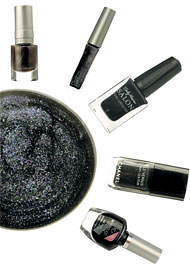
Back in 1994, I was as much of a sucker as any for the dark nail polish rage that swept the nation. My bottle of Chanel Vamp was a treasured pal and I have no problem admitting it.
Here we are now, twelve years later, and the trend has reemerged like a viral plague, attacking every organism with a pulse. I like the dark polish rage, but enough already.
We got it.
That passport to cool has expired and it’s time to reissue.
By the way, don’t look behind the curtain; my nails are only kind of dark right now.
Black Nail Polish: A Brief History
Nails Meet Midnight


Tuesday, November 21, 2006
fun game
IF YOUR LIFE WAS A MOVIE, WHAT WOULD THE SOUNDTRACK BE?
1. Open your library (iTunes, Winamp, Media Player, iPod, etc)
2. Put it on shuffle
3. Press play
4. For every question, type the song that's playing
5. When you go to a new question, press the next button
6. Don't lie and try to pretend your cool...
7. When you're finished, post your answers in comments and tag some other people to do it!
This are the "scenes" followed by my track for that scene in my life:
Opening Credits: President of What?- Death Cab for Cutie
Waking Up: Something Like a Mama- Underworld
First Day At School: Take It Easy- The Eagles
Falling In Love: All Over You- Live
Fight Song: Burma Shave- Tom Waits
Breaking Up: Track 11—Fritz (Oh the irony. Fritz is an ex-boyfriend/musician)
Prom: Here She Comes- B. Fleischmann & Ms. John Soda
Mental Breakdown: The Last in Line- Dio (awesome!)
Driving: Shoot for Thrill- AC/DC
Flashback: Pandering to the Locals- David Cross (stand-up)
Getting back together: Twenty-Three- Four Tet
Wedding: Hurt- Nine Inch Nails (Guess I shouldn't be getting married anytime soon)
Birth of Child: Oomingmak- Cocteau Twins
Final Battle: Left Behind- Aqualung
Death Scene: Lady Marmalade- All Saints (Hey, if you gotta go, might as well make it a party)
Funeral Song: BBH- Nightmares on Wax
End Credits: In Da Club- 50 Cent (Hell ya, that's the ride I just took you on. Word!)
Friday, November 17, 2006
re:sound
there is so much amazing experimentation, mastery, and tradition present in radio, and thankfully there are people with excellent ears and sensibilities sifting weekly through the work to bring the best to the forefront.
if you like radio, stories, ideas, music, and art in general, check out RE:SOUND.
for guys in particular, you might enjoy 'The Women Show,' which gives you a serious glimpse into the life and mind of the opposite sex.
my favorite, however, is april 1, 2006's 'Fake Doc Show,' at the very bottom of the page.
if you like radio, stories, ideas, music, and art in general, check out RE:SOUND.
for guys in particular, you might enjoy 'The Women Show,' which gives you a serious glimpse into the life and mind of the opposite sex.
my favorite, however, is april 1, 2006's 'Fake Doc Show,' at the very bottom of the page.
Thursday, November 16, 2006
suggestions, ideas?
so after thanksgiving, i will be shooting the music video for 'lost melody,' but i am currently without concept for said video.
director chris is working on it, as am i, but i thought it would be fun to open it up and see if anyone has any suggestions, ideas.
hence the posting title; suggestions, ideas?
pretty nifty how that works.
half of a different video for another one of my songs has already been shot, and that one is quite violent and political in nature (it's fun and crazy and bloody and i die, or part of me does. it's all very metaphorical), so it might be nice to take this video in a slightly different direction, but then i'm not married to that idea, either.
a peek of the latter video:

director chris is working on it, as am i, but i thought it would be fun to open it up and see if anyone has any suggestions, ideas.
hence the posting title; suggestions, ideas?
pretty nifty how that works.
half of a different video for another one of my songs has already been shot, and that one is quite violent and political in nature (it's fun and crazy and bloody and i die, or part of me does. it's all very metaphorical), so it might be nice to take this video in a slightly different direction, but then i'm not married to that idea, either.
a peek of the latter video:
Wednesday, November 15, 2006
the mothership has landed

the movie that i have mentioned time and again- the one that my song is on the soundtrack of- has finally arrived.
snow blind will be in theaters dec. 5.
woo-hoo!
congratulations and endless thanks to director christopher j. scott, who has been one of the most solid and generous friends i've ever had; to his brother, the film's editor, glen scott; to producers david schiavone and chris volckmann, who've always been excellent people, personally and professionally; to john dryer, the d.p. who trudged through hellish backcountry to get this amazing footage; and to richard matson for gittin this lovely bitch into theaters. last but not least, congrats and many thanks to neil mclellan at the lodge, who made music of my little song.
CLICK HERE AND MAKE SNOW BLIND YOUR FRIEND.
AND REMEMBER- DEC. 5.
PASS THE WORD.
a pledge
i just saw this and thought it was great.
entirely optimistic, yes, but i'd like to think it is idealistically aligned with the hopes and desires of all those who recently elected for change.
please read.
_______________________
A Liberal's Pledge to Disheartened Conservatives
November 14th, 2006
To My Conservative Brothers and Sisters,
I know you are dismayed and disheartened at the results of last week's election. You're worried that the country is heading toward a very bad place you don't want it to go. Your 12-year Republican Revolution has ended with so much yet to do, so many promises left unfulfilled. You are in a funk, and I understand.
Well, cheer up, my friends! Do not despair. I have good news for you. I, and the millions of others who are now in charge with our Democratic Congress, have a pledge we would like to make to you, a list of promises that we offer you because we value you as our fellow Americans. You deserve to know what we plan to do with our newfound power -- and, to be specific, what we will do to you and for you.
Thus, here is our Liberal's Pledge to Disheartened Conservatives:
Dear Conservatives and Republicans,
I, and my fellow signatories, hereby make these promises to you:
1. We will always respect you for your conservative beliefs. We will never, ever, call you "unpatriotic" simply because you disagree with us. In fact, we encourage you to dissent and disagree with us.
2. We will let you marry whomever you want, even when some of us consider your behavior to be "different" or "immoral." Who you marry is none of our business. Love and be in love -- it's a wonderful gift.
3. We will not spend your grandchildren's money on our personal whims or to enrich our friends. It's your checkbook, too, and we will balance it for you.
4. When we soon bring our sons and daughters home from Iraq, we will bring your sons and daughters home, too. They deserve to live. We promise never to send your kids off to war based on either a mistake or a lie.
5. When we make America the last Western democracy to have universal health coverage, and all Americans are able to get help when they fall ill, we promise that you, too, will be able to see a doctor, regardless of your ability to pay. And when stem cell research delivers treatments and cures for diseases that affect you and your loved ones, we'll make sure those advances are available to you and your family, too.
6. Even though you have opposed environmental regulation, when we clean up our air and water, we, the Democratic majority, will let you, too, breathe the cleaner air and drink the purer water.
7. Should a mass murderer ever kill 3,000 people on our soil, we will devote every single resource to tracking him down and bringing him to justice. Immediately. We will protect you.
8. We will never stick our nose in your bedroom or your womb. What you do there as consenting adults is your business. We will continue to count your age from the moment you were born, not the moment you were conceived.
9. We will not take away your hunting guns. If you need an automatic weapon or a handgun to kill a bird or a deer, then you really aren't much of a hunter and you should, perhaps, pick up another sport. We will make our streets and schools as free as we can from these weapons and we will protect your children just as we would protect ours.
10. When we raise the minimum wage, we will pay you -- and your employees -- that new wage, too. When women are finally paid what men make, we will pay conservative women that wage, too.
11. We will respect your religious beliefs, even when you don't put those beliefs into practice. In fact, we will actively seek to promote your most radical religious beliefs ("Blessed are the poor," "Blessed are the peacemakers," "Love your enemies," "It is easier for a camel to go through the eye of a needle than for a rich man to enter the kingdom of God," and "Whatever you did for one of the least of these brothers of mine, you did for me."). We will let people in other countries know that God doesn't just bless America, he blesses everyone. We will discourage religious intolerance and fanaticism -- starting with the fanaticism here at home, thus setting a good example for the rest of the world.
12. We will not tolerate politicians who are corrupt and who are bought and paid for by the rich. We will go after any elected leader who puts him or herself ahead of the people. And we promise you we will go after the corrupt politicians on our side FIRST. If we fail to do this, we need you to call us on it. Simply because we are in power does not give us the right to turn our heads the other way when our party goes astray. Please perform this important duty as the loyal opposition.
I promise all of the above to you because this is your country, too. You are every bit as American as we are. We are all in this together. We sink or swim as one. Thank you for your years of service to this country and for giving us the opportunity to see if we can make things a bit better for our 300 million fellow Americans -- and for the rest of the world.
Signed,
Michael Moore
mmflint@aol.com
(Click here to sign the pledge)
www.michaelmoore.com
Tuesday, November 14, 2006
the home front
my fantastic workshop professor, zia jaffery, turned me onto this article.
it's long and somewhat dated (but still intensely relevant) but well worth the read.
it's long and somewhat dated (but still intensely relevant) but well worth the read.
On November 8, 2003, at around 7:40 p.m., a convoy of two Humvees drove out of the front gate of the American base at Al Rashid Military Camp, in southeast Baghdad. The mission was to pick up a sergeant who was attending a meeting at the combat-support hospital inside the Green Zone, the secure area where the Americanled occupation authority was situated. The convoy belonged to the scout platoon of Headquarters Company, 2-6 Infantry, First Armored Division. In the rear left seat of the lead vehicle sat a twenty-two-year-old private named Kurt Frosheiser. Frosheiser was from Des Moines, Iowa. The son of divorced parents, he had a twin brother, Joel, and a married older sister, Erin. During high school, he had been a rebellious, indifferent student, and by the age of twenty-one he had become a community-college dropout, living with his sister and her family, delivering pizza, and partying heavily. He had a brash, boyish smile and his father's full mouth and thick-lidded eyes; he liked Lynyrd Skynyrd and the Chicago Cubs; and one day in January, 2003, he flew through the door with the news that he had just enlisted in the Army. His father, Chris, who also lived in Des Moines, wasn't thrilled to hear it. The Frosheisers were not a military family; Chris, fifty-eight, a salesman's son from Chicago with a flat Midwestern accent, had joined the Army reserve in 1969, mainly to avoid going to Vietnam. But he wasn't the kind of father to impose his views on his children—he never pushed Kurt to share his own interest in history and politics—and he didn't try very hard to talk Kurt out of joining up. Their relationship was what mattered, and his son needed his support. A few weeks later, Kurt dropped by his father's apartment around two in the morning, after a night out drinking, and said, "I want to be part of something bigger than myself." Kurt watched the invasion of Iraq on TV, looking, according to his sister, more serious than she had ever seen him. He had an option to get out of serving, but he left home on April 16th for basic training at Fort Knox, Kentucky. In June, the family drove down to see him on Family Day, and Chris was stunned by the transformation: his son stood at perfect attention on Pershing Field for forty-five minutes in his dress uniform. It was the same in August, when they attended graduation: Private Frosheiser, marching, singing with his classmates, "Pick up your wounded, pick up your dead." Chris found the words chilling, but the music, the sharpness of the formation, the bearing of his son, filled him with pride. After the ceremony, Kurt told his father, "You weren't hard-core enough for me." Chris always lingered in the gray areas, asking questions; Kurt wanted the clear light of an oath and an order. They all drove back to Des Moines for their last two weeks together before Kurt would join the First Armored Division, based in Baumholder, Germany. He partied every night, but the departure hung over everyone, and on the last night, when Erin dropped him off at one final party and turned to look at him, he said, "I know," and ran off. Late that night, Kurt told his father, "Well, old man, I'm probably not going to see you for two years." They both started to cry, and Chris ran his hand through his son's crew cut. "I know I'm going to be in some deep shit," Kurt said. "But you know me, I'm a survivor." Chris knew that the words were meant only to comfort him. His son said, "Live your life, old man." In Germany, Kurt was bored and eager to join the rest of the division, which was already in Iraq. Once, on the phone with his father, he noted that weapons of mass destruction might not be found. "We're fucked, aren't we?" he said. His father responded that there might be other reasons for the war, such as democracy in the Middle East. (Condoleezza Rice, the national-security adviser, had offered this rationale in a speech that Chris, a devoted viewer of C-span, had seen.) Chris told him that the W.M.D. threat might just have been the easiest rationale to sell to the public. Kurt wasn't really interested in the politics of the war anyway. He was more concerned about confronting guerrilla warfare. His officers at Baumholder had warned the soldiers not to pick up trash bags, and not to take packages that kids would rush up to give them. Suddenly, Kurt was on a transport plane to Kuwait, where he awaited deployment for a few days. By the end of October, he was in Baghdad. On November 6th, he managed to get online and e-mailed his sister: Our secter that we patrol is a good one we don't get shot at that much nor do we find IEDs (improvised explosive devices) thats their main way of attacking us. They usually put them in bags but now their putting them in dead animals or in concrete blocks to hide them better. It's kinda scary knowing their out there but like I said our secter is pretty secure so Ill be allright. Writing to his father about his first mission in Baghdad, an uneventful night operation, Kurt was more explicit: I found myself thinking that Im in a country where a lot of soldiers lost their lives but where we at it was so quiet except all friggin dogs barking the Iraqis hate dogs so they're all wild probubly never had a bath their whole lives this country is a shit hole they dont have plumbing so they dig little canels and let all the shit and piss run into the streets . . . theyre places that smell so bad you almost throw up. from what I see its goin to take alot longer then Rumsfeld and G.W are saying to get this shit hole up and running. He spoke to his father once, briefly, on the phone. "I.E.D.s, old man, I.E.D.s," he said. On the evening of November 8th, Kurt was sitting on his bunk, sorting and counting his ammunition, when word came of a mission to the combat-support hospital. He was training for his license as a Humvee driver, and he was eager to experience driving through Baghdad by night. In his short time with the battalion, he had earned a reputation as a hard worker who was quick to volunteer. He and his best friend in the unit, Private Matt Plumley, a Tennesseean, raced each other to the vehicle. Because the right rear door was hard to open, they both headed for the left. Kurt got there first. The convoy left the base and began cruising north, toward downtown Baghdad. Five minutes later, on the left shoulder of the dark highway, thirty feet ahead of the convoy, two 130-mm. artillery shells packed with Russian C-4 explosives detonated, in a flash of light, black smoke, flying dirt. Hot chunks of shrapnel tore through the legs of the lead Humvee's driver, Private First Class Matt Van Buren, but he accelerated a few hundred yards along the highway, thinking that he would try to make it to the hospital. Then Staff Sergeant Darrell Clay, who was sitting next to him, told him to stop. In the back of the Humvee, Kurt was slumped in his seat. Plumley checked Kurt's pulse, and found none. Kurt had been looking out the window, which had no glass. His head was turned to the left, and a small piece of metal had penetrated the right side of his skull just below his Kevlar helmet, breaching his brain. Private Kurt Frosheiser was taken by helicopter to the combatsupport hospital in the Green Zone, where he was pronounced dead, at 8:17 p.m. At six-thirty the next morning, a Sunday, the phone rang in Chris Frosheiser's cramped apartment, where he had been living since his divorce. The caller was a lieutenant colonel in the Iowa National Guard; he was two blocks away and trying to find the address. "I have a message from the Army," he said tersely. The previous week, Chris Frosheiser had asked an officer what to expect if something happened to Kurt; the officer had said that he would receive a phone call if Kurt was wounded, a visit if he had been killed. Frosheiser met the lieutenant colonel outside the building and invited him in, hoping it was all a mistake, and they briefly made small talk in the living room. Frosheiser went to the kitchen for a cup of coffee. When he returned, the lieutenant colonel suddenly stood at attention: "I regret to inform you that your son Kurt was killed as a result of action in Baghdad." On November 11th, Veterans Day, Kurt's battalion gathered in formation at the base in southeast Baghdad for a memorial service. A captain, Robert Swope, later wrote an account of the ceremony: At 1430 the ceremony is supposed to begin, but it doesn't start until 1448 because we have to wait for a couple generals to arrive. The memorial ceremony begins with an invocation by the chaplain, and then the battalion commander and the company commander both speak. Two privates who knew the soldier follow them. One of the privates chokes and starts tearing up while giving his tribute. I look around me out into a sea of sad faces and in the very back of the battalion formation I see that one of the female soldiers attached to our unit is crying.  Chris Frosheiser initially wanted to escort his son's body back from Baghdad, or at least meet it at Dover Air Force Base, in Delaware. In the end, it was enough to receive the coffin at the Des Moines airport with thirty family members and friends and see Kurt's face one more time. At the wake, Frosheiser tried to say that his son's courage filled him with awe, but he wasn't able to express himself well. Kurt received a military funeral after a Catholic service, and was buried nearby, in Glendale Cemetery. A few days before the funeral, Kurt's mother, Jeanie Hudson, had told the local paper, "He loved this land and its principles. He loved Iowa. It's an honor to give my son to preserve our way of life." She had become an evangelical Christian, and she said that Kurt had volunteered to fight the forces of evil. For Chris Frosheiser, this was too apocalyptic, suggesting some kind of religious war; he was a Catholic, but he thought that mixing politics and religion—whether Islam or Christianity—was dangerous. Anyway, Kurt had not spoken of the war this way. On the night after Kurt's death, Iowa's governor, Tom Vilsack, had called to offer condolences and said that he hoped the country's policies were as good as its people. Frosheiser was troubled by the thought that it might not be so. In January, 2004, one of Kurt's friends from Fort Knox wrote him in an e-mail, "I don't suppose he was in an up-armored HMMV, was he? Probably not, Uncle Sam wouldn't give us Joe's the good stuff." Frosheiser didn't know the answer, but thinking about it only deepened his grief. Frosheiser dreamed that he was in the Army with Kurt. It was unclear whether they were father and son or friends; both of them were sitting on the right side of the Humvee and, when the explosion came, they fell out together and everything was O.K. He was nagged by the thought that he hadn't had time to send Kurt a book he had requested, Tolkien's "The Return of the King." On his wrist he wore Kurt's watch, still set to Baghdad time, with an alarm that went off at 6:30 a.m.—9:30 p.m. in Des Moines. Frosheiser was a lifelong Democrat. In 1968, as a student at Drake University, he had supported Robert Kennedy for President. He couldn't identify with the antiwar movement, though; he thought that Vietnam was a terrible waste but not a reason to hate your country. Even the Eugene McCarthy campaign struck him as too élite, too unconventional, and when McCarthy said that Kennedy was "running best among the less intelligent and less educated people" it touched the resentful nerve of a lower-middle-class college kid. The Tom Haydens of the world were going to make it no matter how they spent their youth; the Chris Frosheisers had to be more careful. He didn't join the backlash that elected Nixon and Reagan, however; he remained a liberal, mostly on economic grounds. For many years, he worked in the insurance business without enthusiasm; in 1993, he started a new career, as the Salvation Army's director of social services in Des Moines. "I wanted to do something more meaningful—kind of like Kurt," Frosheiser said. Meanwhile, he had grown increasingly unhappy with the "weakness" of Democratic leaders and the anti-military views of much of the Party's base. After Kurt's enlistment and then his death, the feeling deepened into estrangement. Frosheiser venerated those who put on a uniform and served. He was uneasy with friends who called Iraq "another Vietnam," and he couldn't tolerate hearing that Kurt's life had been wasted. When a local Catholic peace group got in touch to offer condolences and let him know that Kurt's picture, along with those of other fallen Iowans, would be on display at a weekly candlelight vigil, Frosheiser told the group not to use Kurt's photograph. But when he bought a long-life candle at a Christian bookshop and told the cashier that it was for his son's grave, and she said, "Thank you for your sacrifice," that, too, sounded wrong. That winter, in the Iowa caucuses, Frosheiser supported Senator John Edwards; he had misgivings about John Kerry. When a friend called Kerry's vote against the eighty-seven-billion-dollar war appropriation a "protest vote," Frosheiser said, "Kind of a serious issue to be casting protest votes on." He wondered if Kerry could hold steadfast in Iraq under pressure from the Party's dissenting base. If not, what would Kurt's death mean then? When President Bush said in a speech, "We will hold this hard-won ground," he found the language inspiring. Kerry's rhetoric did not inspire him. Frosheiser kept remembering Lincoln's 1862 Message to Congress: "As our case is new, so we must think anew, and act anew. We must disenthrall ourselves, and then we shall save our country." He longed to hear words like these from a wartime leader; politics required the art of explanation. But Bush, who had made so many mistakes, was unable to admit or see his errors, even as the war was getting worse; he had the best education money could buy, but he seemed to know little about the world. Frosheiser admired men who seemed driven more by patriotism than by ideology, such as Thomas Kean and Lee Hamilton, of the 9/11 Commission, and Senators Joe Lieberman and John McCain. Iraq was too important to be left to the partisans. Not long after Kurt's death, Chris Frosheiser read a piece I wrote for this magazine about Kurt's battalion. Frosheiser was looking for some way to comprehend Kurt's short life and his death in Iraq. After I got back from Iraq, we began a correspondence by e-mail. Frosheiser's letters were full of the restless questions, the constant return to the same inconclusive themes, of a man who has suffered a trauma and is determined to feel every contour of it: April 1, 2004: Democrats need a foreign policy and a national security strategy to back it up. . . . Now, I have gone on too long and not answered your questions very well. It shows my ambivalence and the difficulty in talking beyond the personal. Sorry. May I write more later? I can't go on now. . . . I have reread Truman's "Truman Doctrine" speech and Marshall's Harvard Commencement speech of June 1947. I admired them and those policies. I must avoid bitterness. In honor of Kurt and the other soldiers, bitterness seems inappropriate. May 15, 2004: Sometimes I think about Kurt being in Baghdad, Iraq, as part of something called "Operation Iraqi Freedom." Kurt said he wanted to be a part of something larger than himself. He was in the middle of something so huge it nearly defies understanding. There is more to be said about this, I just don't know what it is. My son died for something. And there is honor in simply enlisting, let alone serving in Iraq. August 28, 2004: Next Tuesday, George Bush will be campaigning near Des Moines, in a farm community called Alleman, Iowa. Apparently, the campaign invited us as Kurt's family to be there. Joel and I talked about it and Erin too. And we will attend. It is a tribute to Kurt, I think. It may or may not be construed as support for Bush. But, you know, I will put my Democratic loyalty up against anyone's. As a tribute to Kurt I am entitled to shake hands with the President. Besides, it is still a bit odd I think that very little was said to me, a loyal Democrat, by leading Democrats, about Kurt's service. I know a guy who was the state party chair and who was an early Edwards supporter. I had expressed an interest in talking to Edwards about Kurt's service. It was never arranged. I thought someone like Edwards should speak to someone who lost a child in combat. Is there a larger issue exposed here? About Democrats and the soldiers? Sometimes it feels like I don't have a party. John Kerry did send a card to both Jeanie and me, but I really think there is an ill-at-ease sense among activist Democrats about the "warriors" because of opposition to the war. September 5, 2004: In follow-up to my previous e-mail about meeting Dubya, it didn't happen. Out of a sense of obligation to honor Kurt, to receive his Commander in Chief's offer of tribute and condolences I went. We were just part of the crowd. . . . We did get to hear the "stump speech," a longer version of which he gave to the Convention. He speaks of the "war against terror" as if it includes Iraq, no distinguishing between them. . . . I will be happy when the election is over. I can't take much more of the hyperbolic bullshit! September 11, 2004: Grandson Colin spent the night last night. We ate popcorn, visited Borders, watched Star Wars, and this morning took a dip in the pool (a bit cool). Life goes on, ready or not. I have to say that Kurt is never out of my thoughts. Ever. That may not be healthy but it is the way it is. I am 57 years old, George, I may never fully recover from this. And maybe I shouldn't. October 4, 2004: A better Iraq? Is it possible? Why did we go into Iraq? What justifies our remaining? American lives have been lost, precious lives, for what? Can something be achieved that is worthy of the sacrifice? Are there things not known to anyone other than the President and his advisers? No one in the Senate or any of the "attentive" and "informed" organizations? That would justify the sacrifice? And how much more sacrifice can be justified? For us to turn Iraq over to civil war would be hard to take. I don't have the right to advocate continued involvement because of my sacrifice—that would lead to more, many more. What is best for America and Iraq? What is reality on the ground in Iraq? What is possible to achieve? Can Kerry and a team of his choosing do it? It is a great leap of faith. The home front of the first two years of the Iraq war was not like that of the Second World War, and it was not like that of Vietnam. It didn't unite Americans across party lines against an existential threat. (September 11th did that, but not Iraq.) There were no war bonds, no collection drives, no universal call-up, no national mobilization, no dollar-a-year men. Nor did the war tear the country apart. Almost as soon as it began, the American antiwar movement quietly capitulated. On the first and second anniversaries of the invasion, there were large demonstrations in Europe and parts of the Middle East and Asia, but in this country organized opposition was muted by the imperative to support the troops. Candlelight vigils like the one in Des Moines, which displayed the photographs of fallen Iowans, strived for a tone of respectful dissent. In the media, Iraq generated words as bitter as any event in modern American history. But most Americans didn't turn against other citizens, any more than they joined together in a common cause. Iraq was a strangely distant war. It was always hard to picture the place; the war didn't enter the popular imagination in songs that everyone soon knew by heart, in the manner of previous wars. The one slender American novel that the war has inspired so far, "Checkpoint," by Nicholson Baker—a dialogue over lunch in a Washington hotel room between two old friends, one of whom is preparing to assassinate President Bush—has nothing to do with Iraq and everything to do with the ugliness of politics in this country. Michael Moore, the left's answer to Rush Limbaugh, made a hugely successful movie, "Fahrenheit 9/11," in which Saddam's Iraq was portrayed in a crudely fantastical light—a happy place where children flew kites. Iraq provided a blank screen onto which Americans projected anything they wanted, in part because so few Americans had anything directly at stake there. The war's proponents and detractors spoke of the conflict largely in theoretical terms: imperialism, democracy, unilateralism, weapons of mass destruction, preëmption, terrorism, totalitarianism, neoconservatism, appeasement. The exceptions were the soldiers and their families, who carried almost the entire weight of the war. Whereas the street fights of the late nineteen-sixties were the consequence of Vietnam, the word fights of this decade were not the consequence of Iraq—if anything, it was the other way around. It was the first blogged war, and the characteristic features of the form—instant response, ad-hominem attack, remoteness from life, the echo chamber of friends and enemies—helped define the tone of the debate about Iraq. One of the leading bloggers, Andrew Sullivan, responded to the news of Saddam's capture, in December, 2003, by writing, "It was a day of joy. Nothing remains to be said right now. Joy." He had just handed out eleven mock awards to leftists who expressed insufficient happiness or open unhappiness at the news. In response to an Iraqi blogger's declaration of heartfelt thanks to the coalition forces, Sullivan, sitting at his computer in Washington, wrote, "You're welcome. . . . The men and women in our armed forces did the hardest work. They deserve our immeasurable thanks. But we all played our part." Sullivan's joy was, in fact, vindictive and narcissistic glee. (He has since had second thoughts about the Administration's conduct of the war.) Similarly, as the insurgency sent Iraq into tumult most antiwar pundits and politicians, in spite of the enormous stakes and the awful alternatives, showed no interest in helping Iraq become a stable democracy. When Iraqis risked their lives to vote, Arianna Huffington dismissed the elections as a "Kodak moment." It was Bush's war, and, if it failed, it would be Bush's failure. Iraq was too complicated for the simple answers each political side offered. The American invasion brought death, chaos, and occupation to Iraq; it also ended a terrible tyranny and ushered in the possibility of hope. American forces achieved local successes in rebuilding infrastructure and setting up new institutions of government; they also lost ground every day in the estimation of Iraqis. The war had something to do with national security, something to do with oil, and something to do with democracy. Few Iraqis I met felt compelled to rifle through the contradictions and settle on one story line; many of them acknowledged that America, while ridding them of Saddam, had acted out of its own self-interest. But in America there were comparatively few people who could handle the kind of cognitive dissonance with which Iraqis lived every day. Some journalists visited Iraq simply to reinforce their preconceptions. In the summer of 2003, Christopher Hitchens, who had just published a book with the premature title "A Long Short War: The Postponed Liberation of Iraq," flew in with the entourage of Paul Wolfowitz, the Deputy Secretary of Defense, spent several days in Wolfowitz's wake, and came back to tell Fox News that the postwar reconstruction was succeeding splendidly, with the Americans busy rebuilding the place, gathering intelligence, apprehending Baathists, and making friends with the people—none of which was appearing in press coverage. "I felt a sense of annoyance that I had to go there myself to find any of that out," Hitchens told the Fox interviewer. The following March, with the long short war showing signs of turning into a short long war, Fred Barnes, the executive editor of the strenuously pro-war Weekly Standard, parachuted into the Green Zone and discovered that the only thing wrong with Operation Iraqi Freedom was Iraqis. "They need an attitude adjustment," Barnes wrote. "Americans I talked to in ten days here agree Iraqis are difficult to deal with. They're sullen and suspicious and conspiracy-minded." Before the invasion, hawks like Barnes had described Iraqis as heroic figures, but now something had to explain all the bumps in the road. A successful democracy would emerge in Iraq, Barnes said, only after "an outbreak of gratitude for the greatest act of benevolence one country has ever done for another." Naomi Klein, a columnist for the bitterly antiwar Nation, visited Baghdad at the same time as Barnes and found that the insurgency was mushrooming because the occupation authority was "further opening up Iraq's economy to foreign ownership"—in other words, because Iraqis shared her own anti-globalization views. America had become too politically partisan, divided, and small-minded to manage something as vast and difficult as Iraq. Condoleezza Rice and other leading officials liked to compare Iraq with postwar Germany. But there was a great gulf between the tremendously thoughtful effort of the best minds that had gone into defeating Fascism and rebuilding Germany and Japan, and the peevish, self-serving attention paid to Iraq. One produced the Army's four-hundred-page manual on the occupation of Germany; the other produced talking points. In the aftermath of September 11th, President Bush was granted what few Presidents ever get: national unity and the good will of both parties. In the days that followed the terror attacks, something like a popular self-mobilization emerged. Yet President Bush did nothing to harness the surge of civic energy, or to frame the new war against Islamist radicalism as a national struggle. The war on terror should have been the job not only of experts in the intelligence agencies and Special Forces but also of ordinary American citizens. And the war demanded more than a military campaign—it required intellectual, diplomatic, economic, political, and cultural efforts as well. "The Bush Administration has chosen to prosecute this war in a way that the average citizen won't feel the burden," Andrew Bacevich, a professor of international relations at Boston University and a retired Army officer, told me. "The global war on terrorism, a task that's supposed to be equal to that of the greatest generation, is being fought by 0.5 per cent of the citizenry—predominantly people who don't exercise a lot of clout in our domestic politics." Bacevich, in his recent book "The New American Militarism," proposes reviving the role of the citizen-soldier by, for example, tying college scholarships to national military service. "The political leadership of the country needs to expend political capital to make clear that support for the global war on terrorism must come from all sectors of society," he said. "Then they need to put their money where their mouth is and encourage their children to join. If this is such a great cause, let us see one of the Bush daughters in uniform. That would send a powerful message. But it's considered in bad taste even to suggest such a thing." Bush's rhetoric sometimes soared, but his actions showed that he had a narrow strategy for fighting the war, which amounted to finding and killing terrorists and their supporters. His other political agendas, such as tax cuts and energy policy, stirred bitter fights and disrupted the clarity and unity of September 11th. Whatever national cohesion that remained by mid-2002 came undone in the buildup to the invasion of Iraq. The White House forced a congressional vote on a war resolution one month before the 2002 midterm elections, in an atmosphere of partisan invective; Republicans on the floor of the House and Senate accused their dissenting Democratic colleagues of Chamberlain-like appeasement of Saddam. Meanwhile, Senator Joseph Biden, the Democratic chairman of the Senate Foreign Relations Committee, working with his Republican colleague Richard Lugar, drafted a war resolution that stood a better chance of getting bipartisan support; it placed a few constraints on the Administration's ability to act, making it slightly less likely that America would go to war without international participation. The White House maneuvered to block the Biden-Lugar bill and got its own passed, on a more partisan vote. The strategy of Bush's political adviser Karl Rove paid off in November, when the Republicans regained the Senate and added to their majority in the House. But the Administration left behind an embittered Democratic minority and an increasingly divided electorate, just as it was preparing to take the country into a major land war. In the fall of 2002, it still might have been possible for President Bush to construct an Iraq policy that united both parties and America's democratic allies in defeating tyranny in Iraq. Such a policy, however, would have required the Administration to operate with flexibility and openness. The evidence on unconventional weapons would have had to be laid out without exaggeration or deception. The work of U.N. inspectors in Iraq would have had to be supported rather than undermined. Testimony to Congress would have had to be candid, not slippery. Administration officials who offered dissenting views or pessimistic forecasts would have had to be heard rather than silenced or fired. American citizens would have had to be treated as grownups, and not, as Bush's chief of staff, Andrew Card, once suggested, as ten-year-olds. After the invasion, European allies would have had to be coaxed into joining an effort that desperately needed their help. French, German, and Canadian companies would have had to be invited to bid on reconstruction contracts, not barred by an order signed by Paul Wolfowitz (who once wrote that American leadership required "demonstrating that your friends will be protected and taken care of, that your enemies will be punished and that those who refuse to support you will live to regret having done so"). American contractors close to the Pentagon would have had to be subjected to extraordinary scrutiny, to avoid even the appearance of corruption. The U.N. would have had to be brought into Iraq as an equal partner, not as a tool of American convenience. The top American civilian in Iraq might even have had to be a Democrat, or a moderate Republican such as the retired general Anthony Zinni, whom a senior Administration official privately described as the best-qualified person for the job. ("You've got to rise above politics," the official told me. "You've got to pick the best team. You've got to be like Franklin Roosevelt.") The occupation authority would have had to favor hiring not political appointees but competent, non-partisan experts. It would have had to put the interests of Iraqi society ahead of the White House agenda. And when no weapons of mass destruction were found in Iraq the Administration would have had to admit it. The President would have had to scratch evasive formulations like "weapons of mass destruction-related program activities" from his State of the Union address. Officials and generals who were responsible for scandal and failure would have had to be fired, not praised or promoted. When reporters asked the President to name one mistake he had made in Iraq, he would have had to name five, while assuring the country that they were being corrected. He would have had to summon all his rhetorical skill to explain to the country why, in spite of the failure to find weapons, ending tyranny in Iraq and helping it to become a pioneering democracy in the Middle East was morally correct, important for American security, and worthy of a generational effort. In fact, he would have had to explain this before the war, when the inspectors were turning up no sign of weapons, and thus allow the country to have a real debate about the real reason for the war, so that when the war came it would not come amid rampant suspicions and surprises, and America would not be alone in Iraq. The Administration's early insistence on Iraq's imminent threat to national security later made it difficult for many Americans to accept broader arguments about democracy. "What would be worth it?" Chris Frosheiser asked. "W.M.D. imminence? Yeah. Linked to Al Qaeda? Yeah. After that? We're concerned about humanitarianism in Iraq, and the Kurds and all. But democracy in Iraq?" He wasn't so easily convinced. What prevented open and serious debate about the reasons for war was, above all, the character of the President. Bush's war, like his Administration, was run with an absence of curiosity and self-criticism, and with a projection of absolute confidence. He always conveyed the impression that Iraq was a personal test. Every time a suicide bomber detonated himself, he was trying to shake George W. Bush's will. If Bush remained steadfast, how could America fail? He liked to call himself a wartime President, and he kept a bust of his hero Winston Churchill in the Oval Office. But Churchill led a government of national unity and offered his countrymen nothing but blood, toil, tears, and sweat. Bush relentlessly pursued a partisan Republican agenda while fighting the war, and what he offered was optimistic forecasts, permanent tax cuts, and his own stirring resolve. I asked Richard Perle, the former chairman of the Defense Policy Board and a leading war proponent, whether top Administration officials ever suffered doubts about the Iraq War. "We all have doubts all the time," Perle said. "We don't express them, certainly not in a public debate. That would be fatal." Expressing doubts in public would empower opponents. In public, Perle himself essentially said, "I told you so." Soon after the invasion, he told a French documentary filmmaker, "Most people thought there would be tens of thousands of people killed, and it would be a long and very bloody war. I thought it would be over in three weeks, with very few people killed. Now, who was right?" As the war became longer and bloodier, Perle was still right, but in a different way: If only ten thousand Iraqi National Congress members had gone in with the Americans as he had wanted, if only Ahmad Chalabi had been installed at the head of an interim government at the start, all these problems could have been avoided. None of the war's architects publicly uttered a syllable of self-scrutiny. Leslie Gelb worked in the Pentagon during the last years of the Johnson Presidency, and he directed the writing of the Pentagon Papers, the secret history of the Vietnam War which had been commissioned by Robert McNamara, the Defense Secretary, before leaving office. I expressed my doubts to Gelb that Donald Rumsfeld, Bush's Defense Secretary, had commissioned a secret history of the Iraq war. "You can bet your bippy," Gelb said, laughing. "It's not accidental that President Bush, during the campaign, couldn't answer the question whether he ever made a mistake. I've never seen those folks say they were wrong. Vietnam was a liberals' war. This is not." Comparing Bush to his own boss, Gelb went on, "Johnson was a tragic figure. He was driven by the imperative not to lose the war. He knew he couldn't win. Bush is Johnson squared, because he thinks he can win. Bush is the one true believer, a man essentially cut off from all information except the official line." Chris Frosheiser once told me, "I don't expect to hear Bush say he made a mistake, but I want to hear something that shows he knows what the hell he's doing. And I still don't hear that from him. That gets back to the soldier's oath." He was referring to the oath of personal obedience that Kurt had sworn to the Commander-in-Chief. "It implied that the President must be very wise and knowledgeable and have foresight before deploying men, because he's going to be responsible for them." The strategy of projecting confidence served the President well in domestic politics. Steadfastness in wartime is an essential quality, and after the 2004 election no one could reasonably doubt his ability as a politician. For him, the result also proved his critics wrong. "We had an accountability moment, and that's called the 2004 election," Bush said. But in Iraq, which had a reality of its own, the approach didn't work as well. When Bush spoke—as he did in his acceptance speech at the Republican Convention in September, 2004, and again in his inaugural address in January, 2005—about the power of freedom to change the world, he sounded deep notes in the American psyche. But Iraq itself, which was visibly deteriorating, looked nothing like the President's exalted vision. Bush's assertions that the war was succeeding forced the entire government to fall in line or risk the White House's wrath. So agencies sometimes issued prettified reconstruction reports—even when Iraq's electricity grid remained in terrible shape. War is less tolerant of untruth than domestic politics is. Bush's imperviousness to unpleasant facts actually made defeat in Iraq more likely. Sir Jeremy Greenstock, Britain's envoy in Baghdad, watched governments in Washington and London try to bend Iraq to their own political needs and concluded that the Coalition Provisional Authority was hampered by its creators. "You have to make decisions judged against the criteria within and about Iraq, not within and about any other political context," Greenstock told me. "If you want the American and British publics to be happy about the results in Iraq, you don't say, 'What do they want next?' You look at Iraq, and you produce the substance that will make them happy. You don't produce the presentation that might make them happy tomorrow." When Bush's first chief of the postwar operation, the retired general Jay Garner, was replaced by L. Paul Bremer III and recalled from Iraq, in May, 2003, he was taken by Rumsfeld to the White House for a farewell meeting with the President. The conversation lasted forty-five minutes, he told me, with Vice-President Dick Cheney and Rice sitting in for the second half, and yet the President did not take the chance to ask Garner what it was really like in Iraq, to find out what problems lay ahead. When Garner had come back from northern Iraq in 1991, after leading the effort to save Kurdish refugees following the Gulf War, he had answered questions for four or five days. Bush thanked Garner for his excellent service. Garner told Bush, "You made a great choice in Bremer." Garner's end-of-duty report had assured the President that most services in Iraq would be restored within a few weeks. Anyone listening to the conversation could only conclude that Operation Iraqi Freedom was a triumph. "You want to do Iran for the next one?" the President joshed as the meeting came to an end. "No, sir, me and the boys are holding out for Cuba," Garner said. Bush laughed and promised Garner and the boys Cuba. Garner shook hands with the President, then with the Vice-President, who had said nothing the whole time. He told me that he caught Cheney's "wicked little smile" on his way out, adding, "I think the President only knows what Cheney lets in there." On the day before the 2004 election, the senior Administration official told me that Bush "was enshrouded by yes- men and yes-women. George Tenet"—the former director of the C.I.A.—"is at the top of the list: people who can smell the political angle and furnish the information that will give the President what the political angle is. No one ever walks into the Oval Office and tells them they've got no clothes on—and persists." He went on, "I think it's dangerous that we have an environment where our principal leader cannot be well informed." When a transport helicopter was shot down near Falluja in November, 2003, killing fifteen soldiers who were flying out on leave, the public waited for the President to make a statement about the single worst combat incident of the war. Bush said nothing for two days, until, when pressed by reporters while he was touring wildfire damage in California, he put his hand over his heart and said, "I am saddened any time that there's a loss of life. I'm saddened. Because I know a family hurts. And there's a deep pain in somebody's heart. But I do want to remind the loved ones that their sons and daughters—or the sons, in this case—died for a cause greater than themselves, and a noble cause, which is the security of the United States." The President seemed not to know that two of the soldiers in the helicopter were women. Ronald Reagan or Bill Clinton would never have missed such a detail. It wasn't indifference on Bush's part. It was a deliberate strategy of not being told too much, not getting bogged down in the day-to-day problems of the war, not waiting up past midnight for the casualty figures to come in, like Lyndon Johnson in the Situation Room. Not knowing kept the President from appearing distracted and discouraged. And, politically, it worked. Bush never seemed to be a President under siege. To downplay the mounting death count in Iraq, the Administration enforced a ban on the filming or photographing of coffins arriving at Dover Air Force Base. The decision achieved a political success by keeping the death toll an unreality for those Americans who were not personally linked to a soldier. It played its part in making Iraq a remote war. I asked Chris Frosheiser what he thought about the policy. He said, "We need to see the coffins, the flag-draped coffins. The hawks need to see it. They need to know there's a big price to pay. If they don't have skin in the game, they need to see it. And the doves need to see the dignity of the sacrifice. They don't always see that." He wanted to collect Kurt's posthumous medals, his folded funeral flag, his autopsy report, and a photo of the head wound, and take them on the road, making fifteen-minute presentations around the country. He would tell those who supported the war, "Suit up and show up." He would tell war opponents about the nobility of a soldier's duty. Or he wouldn't say anything at all. He simply wanted people to see. The idea of diminishing the threat from the Middle East by spreading democracy, beginning with Iraq, had occurred to the Bush Administration before W.M.D.s turned out not to exist. Some officials had been promoting the notion for years, and the President had made the argument in a speech before the American Enterprise Institute a month before the invasion. But this was hardly the casus belli that the Administration had presented to the American people. When the Administration changed its rationale later on, without ever admitting to the shift, it had every appearance of a bait-and-switch. Nevertheless, the idea deserved to be taken seriously by the political opposition at home and by America's allies. A few Democrats, like Biden and Ambassador Richard Holbrooke, took up the idea without diluting their criticism of the Administration's conduct in Iraq. This was a difficult mental balancing act, but it was also important, because what Iraqis and democracy needed most was a thoughtful opposition that could hold the Bush Administration to its own promises. Yet most of the war's critics, including leaders of the Democratic Party, refused to engage in debate. They turned the subject back to the missing weapons, or they scoffed at the Administration's sincerity, or they muttered about the dangers of utopianism, or they said nothing. As a result, the Administration never felt concerted pressure from the left to insure that Iraq emerged from the war with a viable democracy. The lack of dialogue between the Republicans and the Democrats brought out the destructive instincts of each party, and Iraq got the worst of it. Abdication also left the Democratic Party in a bad position, both morally and politically. The Party's fortunes during the election year came to depend on Iraq's turning into a disaster. When a journalist pointed this out to the antiwar candidate Howard Dean, he said, "I'm hoping against it, but there's no indication that I should be expecting anything else." An informed argument that the American presence in Iraq could only make matters worse deserved a hearing, and some Democrats believed that heavy civilian casualties were reason enough for ending the war. But most critics offered a detached and complacent negativism. The election year proved to be the year in which Iraq did turn into a disaster, yet the Democrats failed to benefit, in part because they had nothing to offer instead. Chris Frosheiser ended up voting for Kerry by a hair, more out of party loyalty than anything else, but, between Bush's attempts at Lincolnian rhetoric and Kerry's unconvincing multi-point plans, a slender majority of American voters went for jury-rigged hope. And yet month after month the war grew less popular. The cynicism on both sides was bound to reach the troops in Iraq. For many enlisted men and women, the mission became harder to understand and justify. Last summer, at the American base outside Mahmudiya, an insurgent stronghold in an area south of Baghdad which soldiers had nicknamed the Triangle of Death, I talked with several of Kurt Frosheiser's platoon buddies, including Matt Plumley, who had been next to him in the Humvee the night he was killed. We sat in a stifling trailer. They were privates, all but one of them in their early twenties, and they expressed a tender and fatalistic affection for the young man they called Fro. "That incident woke me up," Marcus Murphy, a blond, soft-spoken Indianan, said. "These people are trying to kill us." "It's amazing," Plumley said. "We're here trying to help." Latrael Brigham, a black soldier from Texas, took Kurt's death as a failure of leadership. "I was pissed off, because we're riding around here with messed-up equipment. If you send men to war, you have to prepare them and equip them so they can fight. And have a vision of the aftermath of the war, have a plan about how you're going to finish it. And not just jump into it. And not put the whole burden on us Americans. "We got ourselves into something," Brigham went on. "I wish I could have some real answers to why we're here, but I don't think I'll ever have them. Not any time soon." Plumley, Kurt's best friend in the unit, had a shy manner, and his voice had a Southern twang. He was less ready than Brigham to write the whole thing off. "If everyone here hated us, there'd be I.E.D.s every five inches," he said. Brigham said, "I don't see us changing hundreds of years of religion, and I don't see us bringing democracy to the region. We might be here ten years—depends on the casualties, the body bags coming home." Murphy said, "What this country needs is a big civil war. There's so many religions—we need to leave and let them work it out themselves." "I think we might have did it too fast," Plumley said. "I love our democracy, but we can't impose it," Brigham said. "I would hate if we did pull out," Plumley told him. "That would be very selfish for our country. We done messed it up." Brigham said, "I don't think we're going to be here long enough. The insurgency's going to get worse. We can't stop it. There's always going to be more of them." I asked the soldiers about the meaning of Kurt's death. Plumley said that there was a reason that he was alive instead of Kurt, but he didn't know what it was. Brigham remembered Kurt arriving at basic training, out of shape, and beating him by two minutes in the two-mile run. But Kurt had worked hard to become a soldier. "I never seen him in a bad mood," Plumley said. "I think about Fro every day," Brigham said. Plumley was smiling, remembering his friend. He had been the speaker at the Veterans Day memorial who couldn't hold back his tears, and for the first few days he had felt depressed. "Then I thought, How would Fro want me to be if he could see me? Every time I don't want to do something or think it's stupid, I say to myself, 'Would Fro think that? No.' So he gives me a lot of drive." They were all quiet. Then they asked how Kurt's family was doing. For Chris Frosheiser, Iraq posed an unanswered question about his son and his country. He didn't need to be proved right; he needed to find out what was right, in order to honor Kurt and the other soldiers who had died in Iraq. The war that had taken his son became an essential connection to his son, and he wanted to feel a connection, also, to the soldiers with whom Kurt had served and to the country where he had died. Nothing irritated Frosheiser more than when someone urged him to get on with his life. He searched obsessively, even frantically, through poems, song fragments, magazines (he read not just the New Republic but the left-wing In These Times and the right-wing American Enterprise), Army documents, e-mails, the First Armored Division Web site, American history books, tomes on the theory of a just war, Kurt's belongings, and his own memories. "What was my son involved in? Was it right?" he asked. "I'm looking for an account of it that can sit well in my mind and in my heart. I'm proud of Kurt's service. But the whole thing—were these guys misused? And for what?" He never made it easy for himself. Frosheiser wrote to me not just as a father but as a citizen as well. Our e-mail exchange, however, didn't prepare me for the raw grief I encountered when I went to see him last year in Des Moines, over Memorial Day weekend. Within minutes of picking me up at the airport, Frosheiser was in tears; he was in tears when I left his apartment, two days later. His narrow blue eyes were always red-rimmed behind glasses, his fair skin raw with faint lines etched into his cheeks, his nose stuffed up. His sentences were often interrupted by a nervous laugh that broke into a sob before he regained control. The Sunday before Memorial Day, we drove a few miles northeast of Des Moines to the new development of Altoona, where Erin, his daughter, lives. Neighbors were having a cookout in their driveway. (They had continued bringing over food and taking out Erin's trash months after Kurt's funeral.) Erin smiled kindly at her father when she saw that he was upset. "Not already, Dad." After dinner, we went to Erin's house and sat around the dining-room table, where, spread out, were photos of Kurt in his youth; his graduation portrait from Fort Knox, in which he was standing in front of a Bradley armored fighting vehicle; his combat patches; his "Killed in Action" banner, framed in red; his Purple Heart and Bronze Star; and his tricornered funeral flag, in a wooden frame. Erin, a woman in her early thirties with a direct gaze, was having difficulty explaining things to her small children. Her five-year-old son, Colin, kept asking, "Why didn't he shoot them? Why are they there?" Her three-year-old, Madelyn, wouldn't remember Kurt when she grew up. Erin had been trying hard to picture Iraq: the lives of Iraqi mothers, the dangers they lived with. "I have trouble imagining anyone's life but mine," she said. "Does that sound selfish? Sometimes I fear it's going to keep going until we blow up the world. And I wish we had a better plan." When she first saw the photos from Abu Ghraib, she said, "I thought, They blew up my brother—more power to them. Then more rational thoughts came up: We're trying to win them over, and this humiliation isn't helping our cause." She supported the war, but on a bad day in April, 2004, when twelve Americans were killed, she said to herself, "We've got to get out. I don't want other families to go through what we went through. But what do you accomplish? Because we lost Kurt for nothing, then." For her father, the great challenge was simply to keep going. "This one-day-at-a-time thing works for me," he said. "I get in trouble when I start thinking, How am I going to get through these days and weeks and seasons?" "Most days, I just pretend like it didn't happen," Erin said. "Me, too. Sometimes I think it didn't happen—just for a minute. Then I know it did." The alarm on Kurt's watch went off. Frosheiser and I drove back to Des Moines. His apartment felt smaller than it was, because it lacked natural light and had become the cluttered repository for many of Kurt's things—his clothes and sports gear, his CDs stacked next to his father's old records and books, his memorial spurs, plaques, medals, flags. Frosheiser had been sleeping on the living-room couch, as if keeping a vigil, since the day Kurt left for basic training. I slept in Kurt's room. A dust-covered black U.S. Army shaving kit was on the toilet tank; in the closet, desert and jungle fatigues hung above desert combat boots, winter-weather boots, and a guitar. It was a long time before I fell asleep. The grave was a patch of dark earth and green grass, surrounded by the graves of veterans of earlier wars; little Memorial Day flags were planted in each of them and fluttered in the breeze of a beautiful Midwestern spring morning. Frosheiser, in nylon blue sweats, saluted. "Hey, buddy," he said, kneeling to run his hand over the stone marker, which was engraved with a cross and the words Kurt Russell Frosheiser "It was hard to keep the snow off it because it kind of built up all winter," he said. "When the dirt was soft, you could press it and leave your handprints. That was a good thing." He was talking to the grave now. "It's less painful trying to forget it, but you have to keep remembering. Random thing, just a random thing. Kurt said, 'Live your life, old man,' and that could mean I'd be a bitter son of a gun, and I don't want that. That could very easily happen." He was adjusting the long-life candle under blue glass. "We know that people live on in our hearts, but do they live on in another way? We just don't know the answer to that." He slowly got to his feet, and we walked back to the car. "What does it all mean? It means nothing. How we respond is what it means." A Memorial Day ceremony was taking place in a park next to the state capitol, and was attended by a small crowd, including a number of old men in veterans' caps. A woman from the committee that had organized the event recognized Frosheiser and escorted him over to a row of folding chairs, where he exchanged awkward greetings with his ex-wife. Jeanie was wearing a jacket bearing an image of the American flag and the words "These Colors Don't Run," but her face was crumpled with grief. A politician gave a short speech, and then the names of the Iowans who had been killed in Iraq—fourteen of them—were read. Frosheiser stood in line to place a rose beneath an M-16 that had been stuck, bayonet first, into the ground with a helmet perched on top, as had been done at the service in Baghdad. After the ceremony, we drove across the state, toward the Illinois border, to the high-school graduation party of his ex-wife's niece. (Frosheiser wanted to keep family relationships as strong as possible, especially now.) We passed grain silos, seed factories, and fields of early corn and baled hay speckled with the shadows of fleecy white clouds racing across a blue sky. The pleasures of the road seemed to free Frosheiser's thoughts from the morning's burdens. "I wonder what Bush in private thinks about being against nation-building and now being waist-deep in it," he said. "What is that—paradox, or irony?" Since America was extending itself so deeply into other countries, Frosheiser said, the country needed to create a whole cadre of citizens who had been educated in the humanities and were capable of working overseas. "I was thinking of that song the other day, 'Ain't Gonna Study War No More.' Maybe we should study it. Otherwise, we're going to screw it up. Because it's going to be our kids and grandkids doing it." He had heard the new Bush foreign policy described as Wilsonian, an inspiring term. "There's this phrase, 'America the great and the just.' Reagan used to talk about 'the city on the hill.' The first time I heard Condi Rice talking about democracy in Iraq, I got chills up my back. But then you ask, 'How do you do it? Is it necessary?' " Frosheiser drove in silence for a while, and when he spoke again his voice was quieter. "That's where I kind of run up against a wall with regard to Kurt." I asked him what he meant. "Kurt's life—was he worth that? I'd say no. He was more important than that. So I pull back." That night, back at his apartment in Des Moines, we were watching CNN—thirteen Memorial Day-weekend deaths in Iraq—when the phone rang. It was Matt Van Buren, the driver of Kurt's Humvee, calling from Germany, where he was still recovering from his shrapnel wounds. Frosheiser muted the sound and sat up in his rocking chair. The stress of the day had left him with a headache. "I'm not sure what I can ask you," he said to Van Buren. "Let me know if I go too far." On the other end, Van Buren was describing that night. Frosheiser said, "He got whacked on the head pretty good. He never had much of a chance—I understand that. He got hit in the wrong place." I was watching the muted television: terror attacks in Saudi Arabia, gun battles outside Najaf, Special Forces operations in Afghanistan, Memorial Day ceremonies in America. Without sound, these felt like scenes from a war that had already receded into history. "He wasn't able to talk after he was hit, was he?" Frosheiser asked. Listening, he broke into a sob. "But he was trying? Yeah, that sounds like him. I believe it. Yeah, I believe it." | |


a moment to gloat

i just met lasse hallstrom, director of chocolat, cider house rules, what's eating gilbert grape, etc.
he's here at the agency for a meeting.
he shook my hand and introduced himself.
we rode an elevator six floors.
we spoke swedish.
he was nice.
i am star struck.
thank you for indulging my need to gloat.
it's a huge swedish moment.
Friday, November 10, 2006
i am african
So I went to the Keep a Child Alive fundraiser last night at Hammerstein Ballroom, hosted by Alicia Keys and Iman. Now, I won't spend time verbalizing the awkwardness inherent in a bunch of people showing up in their finest to extend their hearts and wallets to those who have nothing (though I think I will have to write about this at some point because I found it unexpectedly upsetting), but I will say my night was absolutely made when one of my favorite musical artists took the stage by surprise.
Her name is Angelique Kidjo, and she is a powerhouse.
I absolutely adore her.
She performed solo and with Alicia and it was incredible.
If you don't know who she is, look her up on iTunes.
Mom, if you're reading this (and I know you are), you would love her. If you don't buy it before I come west, I will bring you a copy.
Other performers of the night, not one of which disappointed, was Damian Marley (who did a killer duet with Alicia on Welcome to Jamrock), the awesomely lyrical Saul William doing a piece from his new book, The Dead Emcee Scrolls, Louis XIV, and last but not least, the one, the only, David Bowie, who finished the night.
And the crowd went wild.


Thursday, November 09, 2006
hello world.
Good morning!!!
How the hell are you today?
Me? Oh, I'm… well, I'm… okay, I am a stressed little monkey, but I'm surviving.
First, my apologies to anyone for whom I have dropped off the map. I know, I know- we have to hang out, chat, etc, and believe me, I want to, but I am on sabbatical at the moment because I have more work than I can handle and the shutting down of my social life is a prerequisite for getting anything done. I miss you all (even you, the blogging community I've never actually met) and I promise to be back at some point in the near future, but for now, I am a phantom ghost.
On other subjects, if you pick up the Barnes and Noble newsletter come Thanksgiving, I am quoted in the profile on the Reggio Writing and Democracy program, which I'm a student of at The New School.
Also, Lost Melody, and the entire Snow Blind soundtrack, will be available for purchase on iTunes later this month (I'll let you know when exactly, as soon as I'm told) and I am stepping back in the studio this coming Wednesday to record something for songwriter John Johnson, which I'll post on completion.
The new apartment is fantastic. I had my first Zabars dinner last night, watched some tele, and fell asleep with my nose in Tennyson's Ulysses by 7pm. I slept until 8am, at which point I had to force myself up to go to work.
Um, I'm tired.
How the hell are you today?
Me? Oh, I'm… well, I'm… okay, I am a stressed little monkey, but I'm surviving.
First, my apologies to anyone for whom I have dropped off the map. I know, I know- we have to hang out, chat, etc, and believe me, I want to, but I am on sabbatical at the moment because I have more work than I can handle and the shutting down of my social life is a prerequisite for getting anything done. I miss you all (even you, the blogging community I've never actually met) and I promise to be back at some point in the near future, but for now, I am a phantom ghost.
On other subjects, if you pick up the Barnes and Noble newsletter come Thanksgiving, I am quoted in the profile on the Reggio Writing and Democracy program, which I'm a student of at The New School.
Also, Lost Melody, and the entire Snow Blind soundtrack, will be available for purchase on iTunes later this month (I'll let you know when exactly, as soon as I'm told) and I am stepping back in the studio this coming Wednesday to record something for songwriter John Johnson, which I'll post on completion.
The new apartment is fantastic. I had my first Zabars dinner last night, watched some tele, and fell asleep with my nose in Tennyson's Ulysses by 7pm. I slept until 8am, at which point I had to force myself up to go to work.
Um, I'm tired.
Sunday, November 05, 2006
moving on up
i finally moved.
uptown.
tonight.
for real.
i’ve unpacked most of my boxes, set up my tv, organized my desk, loaded the bookshelves, and damn it, i feel good.
i have so much more room than i have had in the past. it feels so lux. i plan on installing a jacuzzi in the north west corner of the room, near the dog bed where schnitzel, my sheba inu, sleeps.
ok, it's not that spacious and i don’t have a dog, but it does feel good to be able to stretch my arms out and not have them touch both walls.
and it's so quiet in my room now. i used to be on top of a loud bar with live music. if the bass didn't wake you, then the smokers who huddled and bantered outside the entrance did. it never really bothered me because i was heavy sleeper, but i notice the silence now, and i like it.
i also like the fact that i am across from a gorgeous church, two blocks away from my gym, zabars, two good bookstores, a library, a huge movie theater, and tons of fantastic grocery stores.
now i just have to get used to the altitude.
uptown.
tonight.
for real.
i’ve unpacked most of my boxes, set up my tv, organized my desk, loaded the bookshelves, and damn it, i feel good.
i have so much more room than i have had in the past. it feels so lux. i plan on installing a jacuzzi in the north west corner of the room, near the dog bed where schnitzel, my sheba inu, sleeps.
ok, it's not that spacious and i don’t have a dog, but it does feel good to be able to stretch my arms out and not have them touch both walls.
and it's so quiet in my room now. i used to be on top of a loud bar with live music. if the bass didn't wake you, then the smokers who huddled and bantered outside the entrance did. it never really bothered me because i was heavy sleeper, but i notice the silence now, and i like it.
i also like the fact that i am across from a gorgeous church, two blocks away from my gym, zabars, two good bookstores, a library, a huge movie theater, and tons of fantastic grocery stores.
now i just have to get used to the altitude.
Friday, November 03, 2006
kids these days
if you've ever wondered what is going on in the bright and brilliant minds of our future, aka college students, here is the dialogue taking place on the back of the women's bathroom stalls at the new school.


other notes:
1. i'm sick. i hate being sick.
2. i'm having a great time staying with my girlfriend anne, who generously offered my her couch in greenpoint for me to sleep on during the interim period between leaving my old apartment and moving into my new one, which i do tomorrow.
3. i went to the rolling stones concert at the beacon theater on wednesday and was as close to the stage as humanly possible. it was there that i experienced the hands down best moment of my concert going life- keith richards getting down on his knees and playing his guitar a foot from my face. he gave a friend on the other side of the stage his pick later in the concert.
yeah, i can die happy now.
4. i just landed an interview with someone i've been working hard and sorting through a lot of bureaucracy to get to. it's no one anyone would know and i can't say much about it yet but hopefully it will result in a piece that will be part of a published collection of works distributed by barnes and noble in the relatively near future. i'll keep you posted.
Subscribe to:
Posts (Atom)
About Me

- Alexis Stember
- “Knowing is not enough; we must apply. Willing is not enough; we must do.” -Johann Wolfgang von Goethe